
Medical Gas Source Redundancy: What ISO 7396-1 Really Says
- delicia
- Reading time: 5 min.
Table of Contents
In healthcare facilities, medical gas pipeline systems are among the most critical infrastructures. Medical oxygen, medical air, vacuum and nitrous oxide continuously supply vital equipment in operating rooms, intensive care units and critical care departments. Unlike other technical installations, an interruption in supply can have immediate consequences for patient care.
It is precisely to prevent this risk that ISO 7396-1 requires an architecture based on source redundancy. The principle is simple: to ensure a continuous supply of medical gases, even when equipment fails or has to be taken out of service for maintenance.
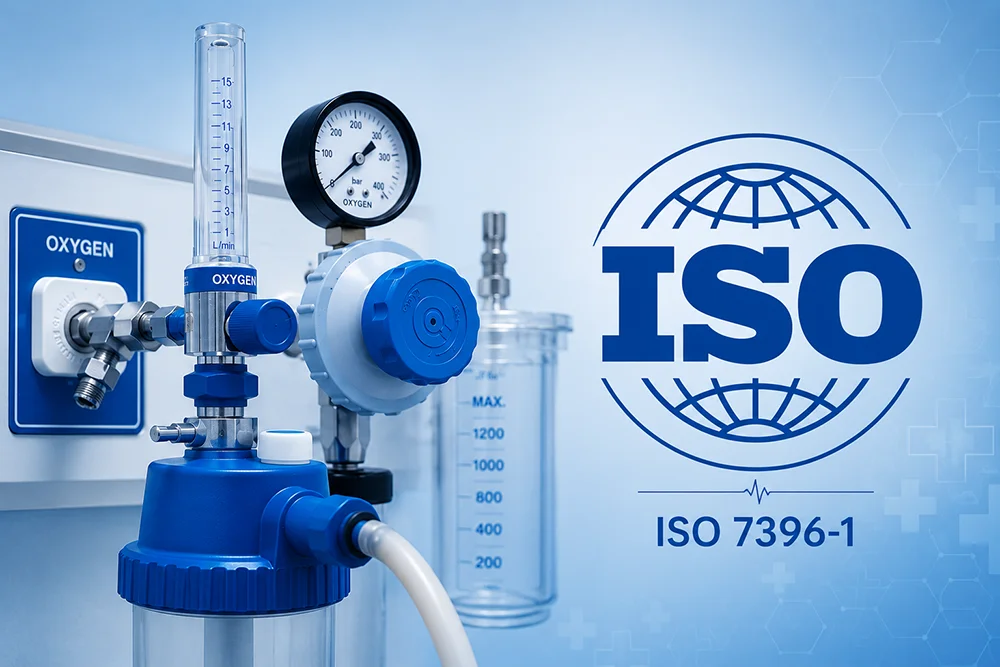
Safety Above All
Redundancy is not simply a matter of “providing backup cylinders.” In medical gas pipeline systems, it is an integral part of the overall system design.
ISO 7396-1 specifies that installations must ensure a continuous supply of medical gases at the specified pressures, flow rates and quality levels. This means that no single failure should result in the complete shutdown of the pipeline system.
In practice, this approach involves multiple levels of safety to ensure:
- continuity of supply,
- pressure stability,
- the ability to perform maintenance without interrupting supply,
- patient safety in all foreseeable situations.
This approach is now considered a standard principle in modern hospital design.
The Three Levels of Supply Sources According to ISO 7396-1
To achieve this level of safety, medical gas pipeline systems generally rely on three distinct levels of supply: the primary source, the secondary source and the reserve source.
The Primary Source
The primary source ensures the normal operation of the pipeline system. It covers the healthcare facility’s day-to-day requirements and acts as the priority supply source.
Depending on the size and organization of the hospital, this source may be :
- a cryogenic liquid oxygen tank,
- a PSA oxygen generator,
- a medical air plant,
- a cylinder bank,
- a compressor system.
In large healthcare facilities, liquid oxygen remains widely used. However, PSA oxygen generators are increasingly being adopted due to the autonomy they provide and the reduction in logistical constraints associated with oxygen deliveries.
The primary source is sized to meet normal consumption requirements, but it is never considered sufficient on its own.
The Secondary Source
The secondary source provides the first level of backup for the system. Its role is to automatically take over if the primary source becomes unavailable.
This unavailability may result from:
- a technical failure,
- maintenance operations,
- a drop in pressure,
- depletion of the available capacity.
One of the key aspects of ISO 7396-1 concerns the automatic changeover between sources. The switch must take place without requiring immediate human intervention in order to prevent any interruption in supply.
In practice, redundancy can take several forms. It may involve a second plant, a second generator, another cylinder bank or an additional storage tank.
Many modern installations use an “N+1” configuration. This means that an additional unit is provided so that the system can continue to operate normally even if one module fails.
This modular architecture is now widely used in modern hospital installations, particularly for PSA oxygen generators, medical air plants and medical vacuum systems. It helps maintain continuity of supply while facilitating maintenance operations.
The Reserve Source
The reserve source represents the final level of safety provided by the installation. It is intended to maintain continuity of supply when the primary and secondary sources are no longer able to supply the pipeline system, or during exceptional situations requiring additional autonomy.
Depending on the configuration of the healthcare facility, the reserve may consist of a high-pressure cylinder bank, cryogenic storage or another independent source that meets the requirements of ISO 7396-1.
It comes into operation when the other sources are no longer available or when an exceptional situation occurs.
In many hospitals, the reserve consists of high-pressure cylinders connected to an emergency manifold. Although it may only be used occasionally, this reserve plays a fundamental role in the overall resilience of the system.
In particular, it makes it possible to:
- maintain supply during technical interventions,
- secure critical hospital departments,
- ensure a minimum level of continuity under degraded operating conditions.
This multi-level architecture directly reflects the safety philosophy of ISO 7396-1: no single failure should result in the shutdown of the medical gas pipeline system.
Changeover Time: An Often-Underestimated Factor
Having multiple sources is not enough to guarantee continuity of supply. The transition from one source to another must also be carefully controlled.
During a changeover, the system must not cause:
- any perceptible interruption,
- a sudden drop in pressure,
- flow instability,
- any impact on connected medical equipment.
To achieve this level of reliability, installations use automatic changeover systems, redundant pressure regulators and continuous monitoring of pressures and alarms.
ISO 7396-1 requires source changeover devices to maintain continuity of supply to the pipeline system. Changeover and pressure regulation systems must therefore be designed to prevent any interruption that could affect the medical equipment being supplied.
Redundancy Goes Beyond Supply Sources
A common misconception is that redundancy only concerns gas production. In reality, ISO 7396-1 applies this safety approach to the medical gas pipeline system as a whole.
System safety also relies on:
- electrical power supplies,
- pressure regulators,
- alarms,
- isolation valves,
- monitoring systems,
- the organization of the different pipeline zones.
This comprehensive approach allows maintenance operations to be carried out without interrupting patient care and enables certain sections of the pipeline system to be isolated without affecting the entire healthcare facility.
This safety philosophy explains why medical gas pipeline systems are considered critical hospital infrastructure.
How PSA Oxygen Generators Are Changing System Architectures
The growing adoption of PSA oxygen generators is gradually changing the architecture of hospital medical gas systems. Many healthcare facilities are now implementing hybrid configurations that combine several technologies.
For example, a system may include:
- a PSA oxygen generator as the primary source,
- a cylinder bank as a backup source,
- liquid oxygen storage as a strategic reserve.
This configuration can strengthen the healthcare facility’s autonomy while reducing the costs and logistical constraints associated with liquid oxygen supply.
ISO 7396-1 does not favor any particular technology. What matters above all is the system’s ability to guarantee:
- continuity of supply,
- gas quality,
- pipeline system stability,
- patient safety.
Conclusion
Source redundancy is much more than a regulatory requirement. It is a fundamental principle of the safety of modern medical gas pipeline systems.
Through ISO 7396-1, medical gas pipeline system design requirements aim to ensure continuous supply, even in the event of equipment failure, maintenance operations or exceptional circumstances.
In a hospital environment where medical gases play a direct role in patient care, continuity of supply can never be left to chance.
Frequently Asked Questions About Medical Gas Source Redundancy According to ISO 7396-1
ISO 7396-1 requires a source configuration designed to ensure continuity of supply to the medical gas pipeline system. Depending on the type of gas and system configuration, this may include a primary source, a secondary source and a reserve source.
The primary source supplies the system during normal operation. The secondary source takes over if the primary source becomes unavailable. The reserve source provides an additional level of security when the other sources can no longer maintain the required supply.
The system must be designed to maintain continuity of supply when a source becomes unavailable. Depending on the system architecture, automatic changeover devices allow the supply to switch to another source without an interruption that could adversely affect the medical gas pipeline system.
Yes. A PSA oxygen generator can be part of a medical oxygen supply system. However, the installation must meet the applicable requirements for gas quality, capacity, monitoring, safety and continuity of supply.
Redundancy allows part of the installation to be taken out of service while the remaining sources continue to supply the pipeline system. A properly designed architecture therefore enables planned maintenance to be carried out without interrupting supply to the relevant hospital departments.
No. ISO 7396-1 covers pipeline systems for compressed medical gases and vacuum within its scope. The principles of continuity and safety therefore also apply, as appropriate, to other medical gases, medical air and medical vacuum systems.