
Medical fluids for healthcare facilities
- delicia
- Reading time: 5 min.
Table of Contents
Medical fluids are essential components of hospital operations. Their production, storage, and distribution directly contribute to the safety of patient care and the proper functioning of medical equipment.
Medical oxygen, medical air, vacuum, nitrous oxide, and carbon dioxide: each fluid serves specific purposes and requires specialized systems designed to ensure quality, safety, and uninterrupted supply.
In healthcare facilities, the management of these fluids relies on dedicated equipment, secure distribution networks, monitoring and backup systems, as well as compliance with strict regulatory and standards requirements.
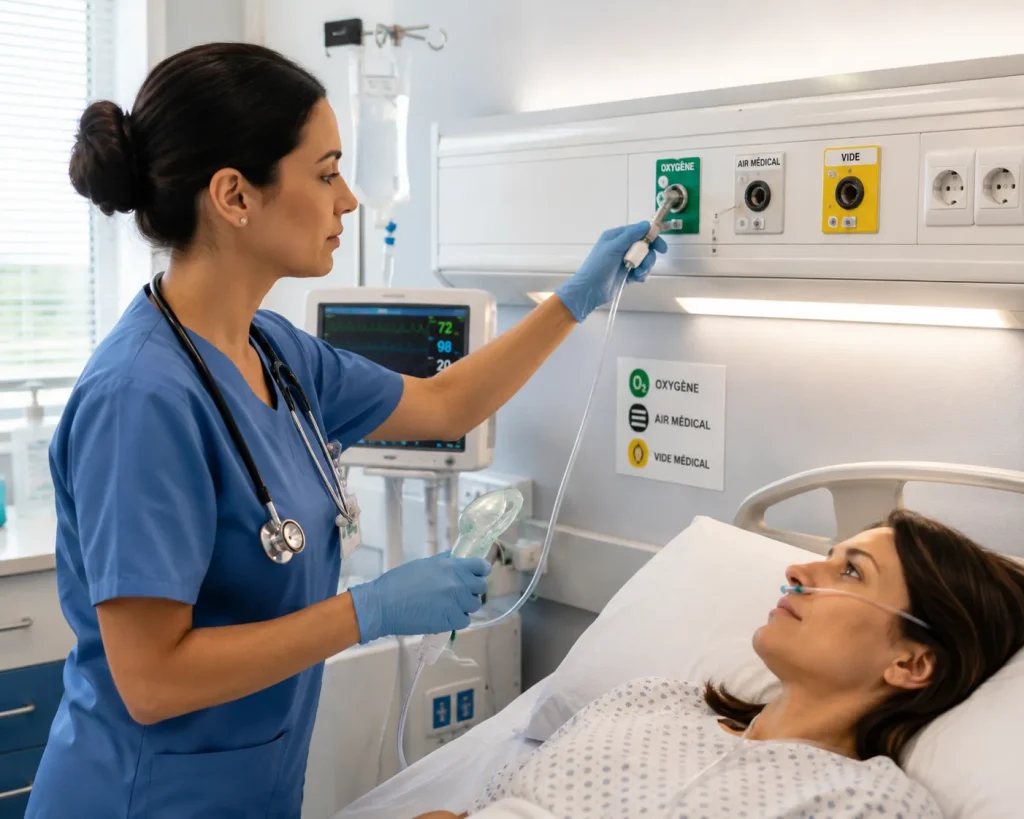
What does the term “medical fluids” refer to?
Medical gases include all gases intended for medical use in hospitals and clinics. These primarily include medical oxygen, nitrous oxide, medical air, nitrogen, carbon dioxide, and medical vacuum. They are used for patient oxygenation, as well as to power medical devices, for ventilation, and for suction.
What are the main medical gases used in healthcare facilities?
The table below summarizes the major medical gases, their key characteristics, and their uses:
| Medical gas | Features | Main Uses |
|---|---|---|
| Medical oxygen | Gas intended for medical use, distributed under pressure | Oxygen therapy, resuscitation, intensive care, anesthesia |
| Medical air | Compressed air that meets the requirements for medical use | Ventilation, respiratory support, powering equipment |
| Nitrous oxide | A gas used primarily for its anesthetic and analgesic properties | Anesthesia, Analgesia |
| Whipping | An inert gas used in certain medical and technical applications | Laboratory, cryotherapy |
| Carbon dioxide (CO₂) | Gas used in various medical procedures | Endoscopy, Surgery |
| Medical vacuum | Vacuum generated by a vacuum pump and distributed through a network | Medical and Surgical Suction |
The availability of these fluids must be tailored to the needs of each facility and its various departments.
How are medical fluids distributed in a healthcare facility?
In a healthcare facility, medical fluids are typically delivered from one or more supply sources to the various departments via a centralized network of piping.
Depending on the fluid in question and the facility’s layout, the supply may come from various sources: on-site production, cylinders or cylinder racks, storage tanks, or vacuum and medical air stations.
The network then supplies terminal outlets located as close as possible to the areas of use: operating rooms, intensive care units, emergency departments, patient rooms, or other care areas.
Regulation, control, and alarm equipment is used to monitor distribution conditions and detect any anomalies.
Producing medical oxygen directly on site
Traditionally, healthcare facilities can be supplied with oxygen in cylinders or in liquid form. Another approach involves producing medical oxygen directly on-site using oxygen generators.
These systems extract oxygen from the ambient air to provide the facility with a local source tailored to its needs.
On-site production offers the following benefits:
- increase the facility’s self-sufficiency in oxygen supply
- reducing dependence on regular deliveries of oxygen cylinders or liquid oxygen
- produce oxygen as close as possible to the point of use
- to minimize certain logistical constraints related to transportation and storage
- adapt production capacity to the facility’s needs
The selected solution must be sized according to various parameters, including the facility’s consumption, the required flow rates, emergency needs, and the organization of the distribution network.
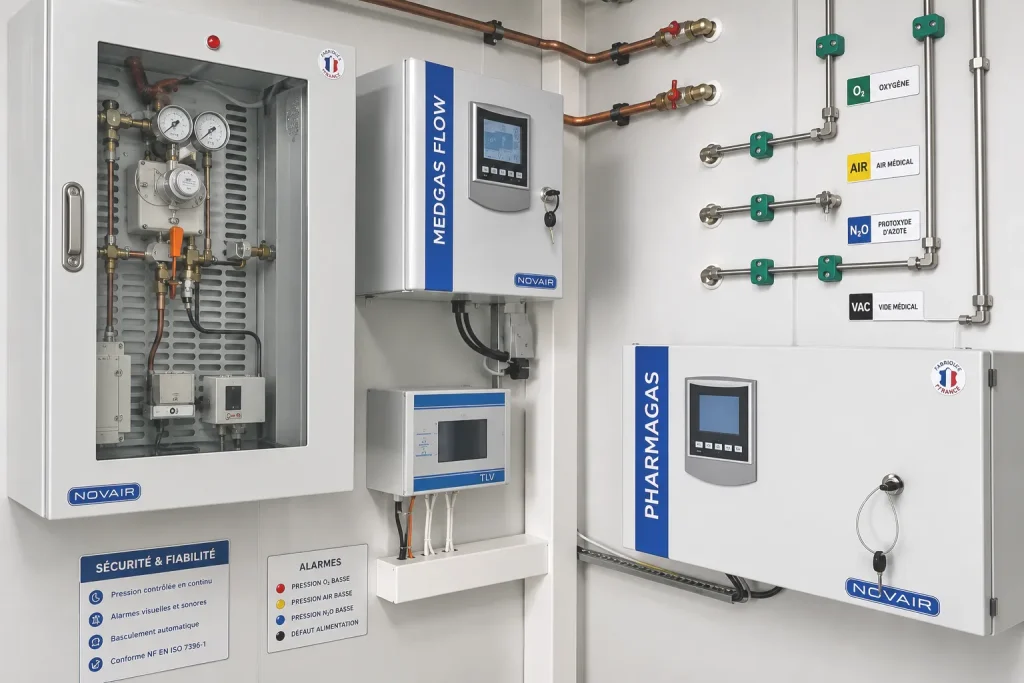
How can we ensure the safety and continuity of the supply of medical fluids?
The safety of a medical fluid system relies on several complementary levels of protection. The goal is both to guarantee the quality of the gas supplied and to ensure the continuity of the supply, even when a piece of equipment or a source becomes unavailable.
In particular, these systems include:
- monitoring and alarm systems, which allow for the monitoring of system parameters—particularly pressure—and the rapid detection of any anomalies
- redundant supply sources and backup systems, which maintain the supply when a primary source becomes unavailable
- clear identification of networks and gases, to minimize the risk of errors during operation or technical interventions
- preventive and corrective maintenance operations, designed to preserve equipment performance and availability
- documentation and traceability of operations, necessary for tracking inspections, maintenance, and interventions
Redundancy of supply sources thus plays an essential role in the design of a medical fluid network. A system must be designed so that a failure or maintenance operation does not result in an interruption of supply to the affected services.
What are the standards and regulations that apply to medical fluid systems?
Medical fluid distribution systems are subject to strict requirements designed to ensure patient safety, uninterrupted supply, and risk control throughout their operation.
In particular, NF EN ISO 7396-1 serves as a reference standard for compressed medical gas and vacuum distribution systems. It defines requirements regarding their design, installation, operation, testing, commissioning, and documentation.
However, a system’s compliance is not limited to its initial design. Its long-term operation also requires an appropriate organizational framework that includes maintenance, inspections, alarm management, emergency procedures, and traceability of interventions.
These requirements must be taken into account from the design phase of the network through the entire service life of the facility.
Why is the maintenance of medical fluid systems essential?
Maintenance directly contributes to the availability and reliability of facilities. It helps identify operational deviations, monitor equipment, and anticipate certain failures that could affect distribution.
A tailored maintenance program may include, among other things:
- periodic inspection of equipment;
- monitoring of operating parameters;
- checking alarm and safety devices;
- maintenance and replacement of relevant components;
- recording and tracking of maintenance activities.
Maintenance must be organized in accordance with the characteristics of the facility, the recommendations applicable to the equipment, and the procedures established by the facility.
What changes and challenges lie ahead for healthcare facilities?
Today, healthcare facilities are seeking solutions to enhance their autonomy, ensure uninterrupted supply, and maintain control over their medical fluid systems.
Several technological advancements address these challenges:
- On-site medical oxygen production, which allows facilities to produce their own oxygen and reduce their reliance on external deliveries
- Centralized monitoring of systems, with systems that track key network parameters, display operational status, and flag anomalies via alarms
- Monitoring and logging of operational data, which facilitate the analysis of system performance, alarm tracking, and event traceability
- Improved equipment efficiency to optimize performance and better manage energy consumption
These developments share a common goal: to ensure a sustainable supply of medical fluids while facilitating the operation and monitoring of facilities by technical teams at healthcare facilities.
Frequently Asked Questions About Medical Fluids for Healthcare Facilities
Healthcare facilities mainly use medical oxygen, medical air, nitrous oxide, carbon dioxide, nitrogen and medical vacuum. Which ones are used depends on the needs of each department: oxygen therapy, ventilation, anaesthesia, suction, surgery or laboratory applications.
Pressure control helps equipment work correctly and ensures that the terminal outlets in each department are supplied. Regulation, monitoring and alarm devices make it possible to supervise the network and detect variations that could affect its operation.
The choice depends in particular on the type of fluid, consumption needs, required flow rates, site configuration and supply continuity requirements. For oxygen, for example, a facility can rely on deliveries or consider on-site production, depending on its needs and organisation.
Supply continuity relies in particular on an architecture with several sources and backup devices. When one source becomes unavailable, another can take over to keep the network supplied. Alarm monitoring and regular equipment maintenance also contribute to this continuity.
Medical fluids installations are subject to strict requirements to ensure patient safety and supply continuity. The NF EN ISO 7396-1 standard is the reference for compressed medical gas and vacuum distribution systems. It covers their design, installation, operation, testing, commissioning and documentation.
Facilities must also ensure monitoring and maintenance of the installations, management of alarms and backup systems, and traceability of operations. The equipment concerned must also meet the regulatory requirements that apply according to its nature and use.